 Back to insights
How AI companies are reshaping the workplace; through their products and cultural playbook
There is a divergence of cultural playbooks underway, that is re-shaping the employee experience within Tech.
Last updated:
Share this post


AI-driven productivity gains are reshaping hiring strategies – companies are holding-back on recruiting for roles expected to be replaced by AI, while redefining others.
But it doesn’t stop there. I have recently posted on LinkedIn my observations on how AI’s impact on the workplace is potentially deeper than this. How many AI scale-ups are alighting on a preferred cultural playbook, and how this is reordering the make-up of employment opportunities available in a small, but growing, portion of the Tech sector.
These AI scale-ups are deploying a matter-of-factly “hardcore” working style, and one that is at odds with the more humanistic, ultra-flexible cultures that peaked in adoption early 2022.
At Hawkwood, we recruit People & Talent (HR) professionals into innovative growth companies across Europe and the US. Given this, my perspective is primarily on how the aforementioned factors are impacting the profile of talent being recruited into these companies. I view this from the perspective of candidates interested in seeking employment, and hiring companies looking to gain an edge in attracting the best talent.
“Not a typical 9-5”
Among AI start-ups, there is a growing cohort pursuing a fully in-office working style. In some cases – in San Francisco and New York – they are even posting opportunities requiring 6 days per week in the office.
The Economist recently shared data which suggests that, whilst there are various compromises inherent with demanding a fully on-site presence, these teams are disproportionately strong at responding to change. At this early stage of AI development, when one LLM update from OpenAI, Gemini or Grok can make or break entire business models, it is not hard to understand why this level of agility is deemed important.
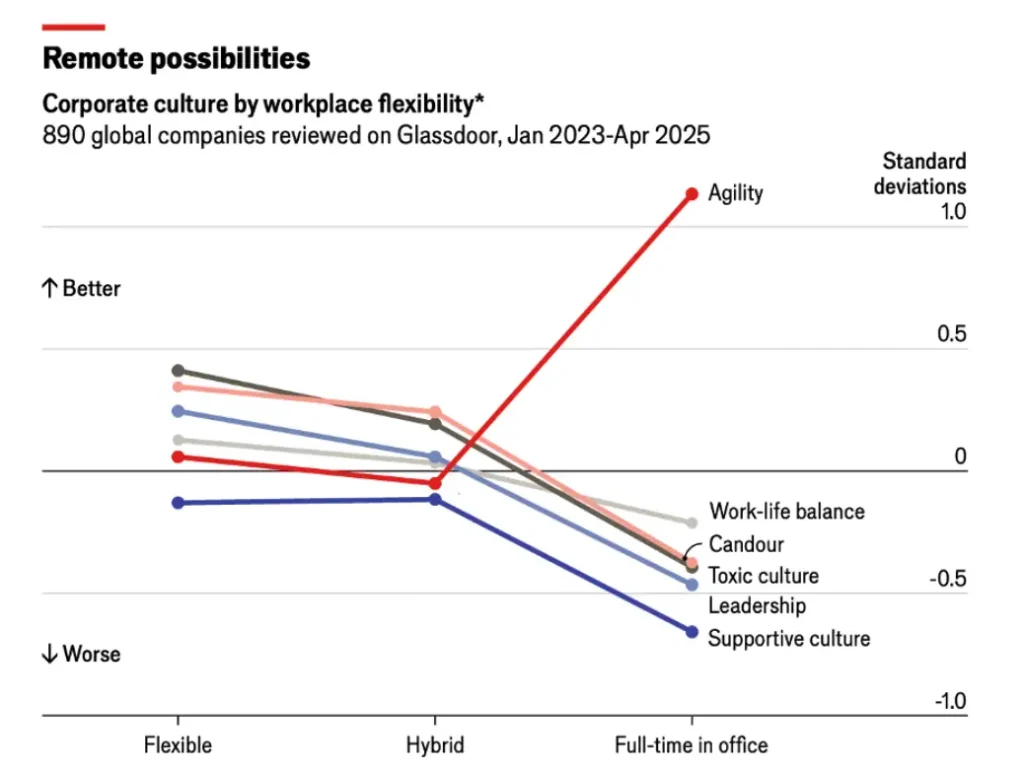
Credit: The Economist
The leadership teams of these companies presumably believe there is a narrow window to secure first mover advantage in enormous markets. They are very transparent in wanting to recruit people prepared and able to commit everything to their mission, in exchange for a share of the potentially enormous spoils.
These roles are being actively marketed as “not a typical 9-5”, and therefore preclude a significant proportion of the candidate pool. An unequivocal antidote to building diverse teams – this trend is, sadly, a significant blocker in enabling many people with family commitments to benefit from the rewards on offer within these high-potential companies.
However, over the past year, we’ve spoken with individuals at leading AI companies feeling burnout and a desire for greater flexibility. Naturally, this does create a clear opportunity for employers who can meet these needs to swoop in.
As the broader job market continues to improve and the market for talent becomes more competitive, we will likely see a degree of shift back towards more employers catering to those needs, but it’s hard to predict how quickly, whether this will have become more widespread, and how much it will swing back by.
Lean, experienced teams
Today’s scale-ups are placing an (even stronger than usual) emphasis on hiring individuals who can build and sell products, with business support functions a more distant after-thought.
Where founders once highlighted headcount growth as a success metric, today it’s revenue per employee that’s being celebrated on LinkedIn and in the tech press.
Of course, this may – in part – be intended as a signal of how adept they are at deploying AI tools like n8n & Make and, therefore, how technologically advanced they are. But it feels deeper than this…
After all, the “do more with less” movement was born out of the financial constraints of higher interest rates, but many of these AI scale-ups have closed $100m+ funding rounds. Indeed, it feels their preference for being lean has now become cultural – or even based on a matter of principle.
I believe this is an interesting topic for discussion, and will prove divisive if it continues to play out. Among some CEO’s, we’re seeing a form of rebellion against the conventional corporate playbook – Elon Musk-style. It started mid-2024 with the dismantling of DEI teams, and has since seen initiatives such as high-profile AI scale-ups rejecting the idea of job titles and, essentially, any form of hierarchy by insisting that all of their leaders do their own admin and recruiting.
We analysed 30 AI scale-ups that have raised a Series A or beyond across Europe and the USA. Pre-2023, start-ups typically hired a Head of People once in the 30-40 employee range. Why are they not currently doing this in the same way – is it the desire to be lean or is that only part of the tale? Could it be that they assume, right or wrongly, that a People/HR Leader may push-back on their approach to managing people; the aforementioned corporate rebellion principles? Is that a debate they feel they have time to engage in amidst this AI boom?
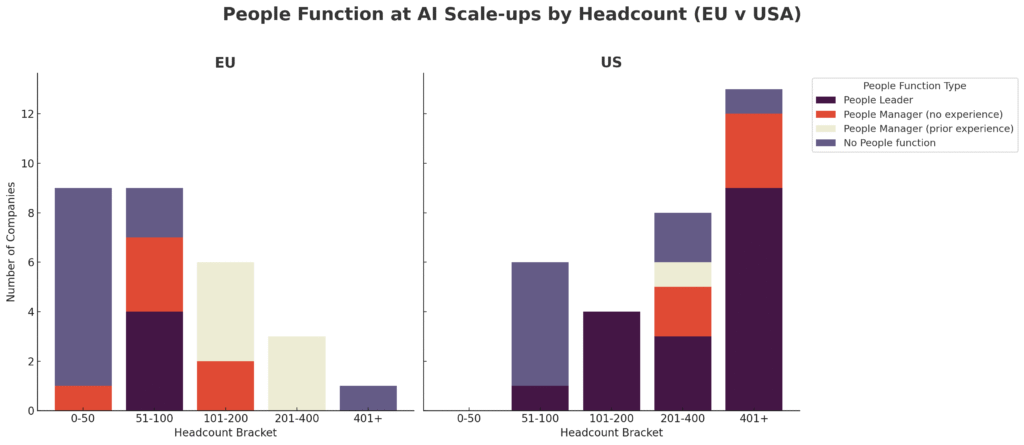
Chief cook and bottle washer
This new breed of AI companies are seeking employees who can lead and do – potentially covering two or more roles. This is likely, at least in part, why they end up being “not typical 9-5” positions.
At Hawkwood, we’re speaking to VP’s People who are being tasked with direct-sourcing candidates for vacancies, and doing all of the HR admin in a stand-alone role, despite the business having many hundreds of employees. Presumably the belief is that this should either already be automated, or will be imminently. Maybe they even feel the ongoing hassle of having to do it acts as a natural incentive to speed that automation process up – who knows.
It’s certainly the case that candidates who seem motivated by building a team underneath them are losing out to their “scrappier”, hands-on peers in many of the start-up roles we’ve handled – in a way that is more noticeable than usual, given there are relatively few of these opportunities around. It’s making life difficult for anyone with a FAANG/Mag-7 background seeking to move into start-ups too – at least in the People & Talent functions that we recruit.
Getting a foothold
It’s a tough time to be launching a career right now. With VP’s doing their own admin, and businesses holding out for an AI solution to do research and coordination-work, there isn’t an obvious entry point for trainees.
AI currently struggles with two things. “Judgement” and “taste”. Judgement comes largely from experience – executives who have developed pattern-recognition over time, who can read between the lines and operate within nuance.
Taste, is arguably less reliant on extensive experience, at least in many contexts. Perhaps this is an opportunity for those starting out. Product design and branding, but also art, ideation, copywriting and humour. Albeit, this is quite a narrow segment of the market, so unlikely to accommodate most young people.
Potentially, the smartest and most creative will find their way into “office jobs”, with many others pursuing apprenticeships into a trade/craft, or maybe this is just all being overblown.
Conclusion
There is a divergence of cultures within Tech underway. At one end is the conventional employer. The majority, who remain loyal to hybrid-working and amid the proposed productivity gains of employees with work-life balance.
At the other end, there are (mostly AI) scale-ups very matter-of-factly offering strong compensation and equity upside potential in exchange for prioritising one’s job above all else for a period of time.
And it feels as though this is all happening at a time when polarisation is increasingly apparent across society – not least in politics.
In this article, I have proposed that I believe these developments are now (at least) partly cultural, and therefore likely shaped by politics.
The US election result and Elon Musk’s acquisition of X have re-shaped the discourse among a significant proportion of business leaders. DEI, wellbeing and even remote work finding themselves in the firing line. I’m convinced this has played a role in diverging company cultures, in this same way it has people’s political views.
But maybe it’s simpler than this? We’ve seen Base44 sell to Wix for $80m only 6 months after launching. Perhaps stories like this are enough of an incentive for collections of people to come together and throw everything they physically can into their jobs, for what they hope will be a short sprint to a pot of gold. Perhaps the force behind this is, in fact, money alone.
Maybe AI Founders are not building businesses that are designed to sustain on their own, but are building products intended to become a new expensively-acquired feature of our favourite social media platform, smart phone or search engine.
Some people are happy to work very long hours in exchange for large sums of money. Personally, I regard hard work as noble, and I respect and admire both their determination and contribution. I assume, in many cases, they love what they do and, in addition to being financially beneficial, it is also a form of creative expression and, thus, joy.
On the flip side, I’m grateful that so many companies continue to offer flexible working and the more conventional employee experience, as there are so many people for whom this “all-in” employment contract is not viable.
Despite the near-term job market challenges I have laid out, I don’t worry about the success of those requiring more flexibility. As the economy recovers, there will be enough demand for talent that we will see a form of rebalancing; with employers competing on all fronts to attract and retain talent – including catering to their human needs.
Rather than destroy net jobs, I believe AI will change them. This means a home for everyone, and potentially even one that offers a greater outlet for creativity and craft.
Thanks for reading
Kristian
Hawkwood builds People & Talent teams on behalf of innovative growth companies across Europe and the USA. Our clients include Series A start-ups through to post-IPO multinationals.
Subscribe to quarterly insights
By clicking Sign Up, you’re confirming that you agree with our Terms and Conditions.